
REVENUE
$1 billion
in new tax revenue to the City over 15 years
Auburndale Technology Center
The Auburndale Technology Center is a modestly scaled data storage and computing facility on a 75-acre existing industrial property within the Central Florida Innovation District near Florida Polytechnic University and Interstate 4. Designed to specifically address the shortcomings of hyperscale developments, the Auburndale Technology Center will provide significant benefits to the residents of the City of Auburndale and the region.
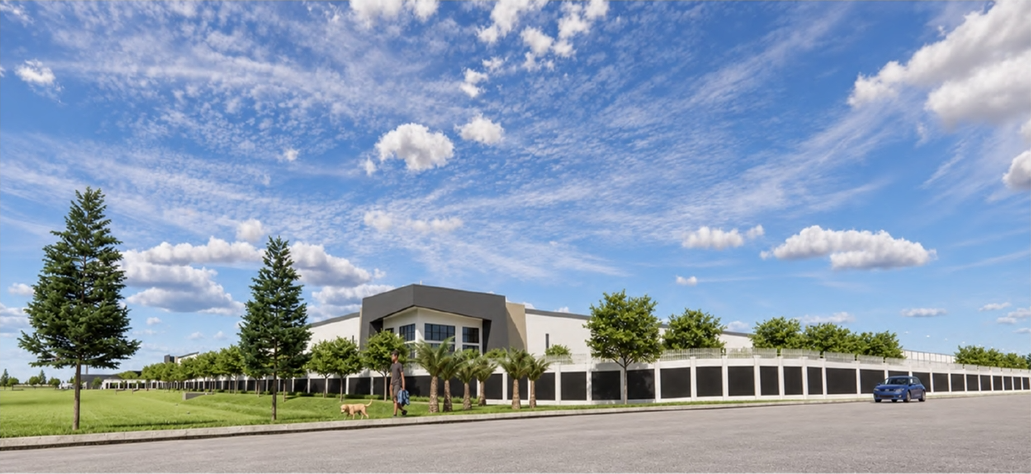
Address: 810 Pace Road, Auburndale, Florida 33823
About the Project
Located within the Central Florida Innovation District, the Auburndale Technology Center represents the next evolution of the 30-year Florida High Tech Corridor vision. Built on existing industrial property, it demonstrates that data infrastructure can be developed responsibly at a modestly scaled size.
The facility will utilize existing industrial facilities and land already zoned for industrial use, about a tenth the size of hyperscale data centers, while providing significant community and economic benefits for both Auburndale and Polk County.
Community First
A closed-loop water cooling system will use much less water than other approved industrial projects, including warehouses or residential developments, and even less than what is presently approved for distribution center warehouse uses.

Will pay 100 percent of all costs for infrastructure and delivery of electrical power to the facility consistent with new statutory laws governing data centers.
Sound levels will be lower than comparably sized warehouse or logistics facility.
Economic Growth
REVENUE
in new tax revenue to the City over 15 years

ECONOMIC IMPACT
in positive economic impact to the region

JOBS
new permanent jobs with average salaries of $80,000 including 1,300 construction jobs
Questions Answered
Florida has been moving toward a high-tech driven economy for several decades. Thirty years ago, the Florida High Tech Corridor, linking the Space Coast to the Sun Coast, was established to strengthen the regional economy by connecting research institutions with high-tech companies and building a talent pipeline to grow and sustain a future-focused economy. The ATC will be part of that vision.
It will store and process computer data. Demand for this service has been growing exponentially, and it is a critical part of our economy.
The Auburndale Technology Center campus will occupy 75 acres and will utilize existing industrial facilities and land already entitled for data center use. It will be about a tenth the size of most hyperscale data centers.
By 2029, the two existing buildings are expected to be in full operation. Two more buildings are planned but not yet scheduled.
In the first phase, the facility will use 350 megawatts (MW). At full development, the facility will use 700 MW. The Auburndale Technology Center will pay one-hundred percent of all costs to generate and deliver power, consistent with Florida statutory protections for ratepayers.
No. In accordance with state law, one-hundred percent of the cost to serve this facility will be covered by the developer.
Because of investments in redundant electrical feeds to the Auburndale Technology Center, only two emergency backup generators will be necessary, primarily for life-safety, with a small portion devoted for critical network & control systems supporting the facility. Periodic testing will be conducted during normal business hours to ensure systems are functional and up to date, and this periodic testing is typically limited to monthly, 1-2 hour tests, within limits set by the EPA under the Clean Air Act.
No. The ATC did not request or accept any local tax incentives.
No non-disclosure agreements were signed between the city and the developers related to this project.
The Auburndale Technology Center will use a closed-loop water system, which circulates the same fluid through a sealed loop to absorb heat from the building. Because the water is continuously reused rather than replaced, the cooling system does not consume water. The system was designed and analyzed by a nationally recognized engineering firm. This same system is proven safe and reliable and is similar to other closed-loop systems utilized at local hospitals and universities.
A closed-loop system circulates the same water through sealed piping between the chillers and the equipment being cooled. The water never contacts the air and is not evaporated.
No. Under normal operation, a closed-loop system does not consume water. It is filled once, and the same water recirculates in sealed piping. This system is paired with air-cooled chillers, so there are no cooling towers and no evaporation.
Estimated water use is approximately 4,710 gallons per day (GPD). The estimated water use is less than the water use allocated for the warehouse use that was initially planned by the former property owner. For comparison, a warehouse of the same size uses approximately 10,000 gallons per day. A typical golf course uses roughly 100,000 GPD.
The water permit is for domestic use (including uses like restrooms – toilets and sinks – and drinking water fountains). The closed loop cooling system does not consume water.
All of the water in the closed loop system is recirculated.
No. Consistent with Section 5.3.12 of the City of Auburndale Land Development Regulations, cooling system water will not be discharged to the city’s sanitary sewer or stormwater system and will not impact the water supply. Maintenance water (and any spillage or leakage) is captured and reused, and any water not suitable for reuse will be removed from the site by a licensed hauler to a permitted facility.
Risk is managed in layers: the system is designed to limit any issue to a small area, monitored around the clock to catch issues early, and operated under procedures for a quick, contained response:
Designed to limit risk. Losing any section of piping would mean losing cooling to the facility, which could cause significant damage to the computing technology or cause the facility to cease operations, so the system is deliberately designed to be concurrently maintainable. Segmenting valves along main pipes, risers, each floor or zone, and around equipment divide the system into small sections that can be isolated while the rest keeps operating. Isolation valves at each chiller confine maintenance to that chiller, and backflow prevention on the water supply connection protects the public water and wastewater system.
Monitored around the clock. The system has active leak detection with fully automated alarming, 24/7 water chemistry monitoring through the building management system, and 24/7 on-site staff to respond immediately to any alarm.
Quick, contained response. If an alarm occurs, on-site staff close the nearest segmenting valves to isolate the affected section while the rest of the system continues to operate. Any water is contained and recovered, the repair is made, and the section is refilled. Because the piping is divided into small sections, any event is limited in scale.
Based upon a detailed staffing analysis, the project is expected to create approximately 300 permanent campus positions offering competitive wages and benefits, along with roughly 1,300 construction jobs during the peak of the construction phase.
Salary ranges are expected to be between $65,000 to $120,000 with an average of $80,000 annual wages for employees. Over 15 years, a projected $193 million in labor income will be supported.
The Auburndale Technology Center is projected to directly generate more than $1 billion in tax revenue benefit to the city of Auburndale over 15 years, which can be used by local governments for public safety upgrades, transportation and infrastructure improvements, and human services programs. The Auburndale Technology Center is projected to directly generate approximately $617 million in state and local school property taxes. Over the 15-year period, tax receipts to all jurisdictions is estimated to total over $2 billion.
Sound levels are planned to be comparable to the current ambient sound (existing sound as measured by an acoustic engineer is approximately 50db). Sound walls and screening will also be installed around the facility's perimeter for additional sound reduction. Additionally, interior acoustic walls will be installed around the HVAC equipment for the facility. The sound generated from the Auburndale Technology Center is estimated to be less than the sound that would have been generated from the previously planned warehouse distribution facility and the related truck traffic.
An acoustic study was conducted to allow for a facility design that minimizes any sound impacts. Sound control is being addressed with a multi-layered approach that includes selection of lower sound emission equipment along with a dual wall acoustic barrier and buildings to contain sound. The selected cooling systems employ air cooled chillers which use many variable speed, small diameter fans to move air - these smaller fans do not create high levels of low frequency and infrasound in the same ways as first generation data center designs that used very large fans. Additionally, the specific air-cooled chiller selected for this project is equipped with sound-reducing software feature that reduces operational fan speed and therefore sound. Further, because of the additional investment in the power supply to the facility, the site is not reliant upon diesel generators which can also contribute to low frequency sound emissions.
Traffic is expected to decrease compared to a warehouse facility. Repurposing this property for the Auburndale Technology Center eliminates 267 daily semi-truck trips that would have resulted from a previously planned warehouse distribution facility on the same site.
This site is an established industrial area with existing infrastructure and buildings constructed for the previously planned warehouse distribution facility. Prior to acquisition, the land was already cleared and prepared for industrial development. As a result, no current wildlife, wetlands, or natural habitats will be disturbed by the Auburndale Technology Center.
Since the property is located within an existing industrial zoned and developed area and the property is already developed, no negative impacts on residential values are expected in the area. As a part of the Central Florida Innovation District, the Auburndale Technology Center is consistent with the vision for advanced technological uses in this area. The Auburndale Technology Center will be a positive addition to the Innovation District vision. And since the Auburndale Technology Center will provide much more property tax revenue than comparable commercial uses, the proposed use will help pay for new community benefits and can help reduce pressure on other City of Auburndale taxpayers.
Because of the additional investment in the power supply, common air quality concerns of other data centers will not be present at the ATC, due in part to the limited number of backup generators. The air quality impacts will be similar to those of a hospital or school. Additionally, since these buildings will no longer be intended for use as a truck distribution facility, the negative environmental impacts associated with heavy truck use will no longer be present.
The City of Auburndale’s Land Development Regulations require the facility’s exterior lighting to be shielded to minimize off-stie light impacts. Specifically, the Land Development Regulations require full cutoff and fully shielded lighting fixtures to prevent unwarranted distractions that may be caused by glare and that limit off-site impacts. Unshielded fixtures are strictly prohibited under the Land Development Regulations.
About the Developer
The developer is an international real estate investment and development company which has developed master planned industrial, logistics, corporate office, retail, aviation, multi-family housing and other uses throughout the United States and the world.
This project represents the developer's commitment to bringing high-quality, responsibly designed data infrastructure to the State of Florida, with careful attention to environmental stewardship, community benefits, and economic growth.
Have questions or want more information about the Auburndale Technology Center?
Location
Central Florida Innovation District
Learn More
Visit our pages above for detailed information about location, protections, benefits, and FAQs. We'll update this site periodically with project updates and information.
Explore the full details about our project's protections, economic benefits, and regional impact.
View All FAQs